
Done-for-You Dispo VS. Building Your Own Disposition System
Both can move the deal. One gives you access to an established disposition operation. The other gives you the tools to build an operation your company owns, strengthens, and carries into every deal after it.
Compare the approaches
Use an operation
someone else built.
You trade part of the transaction economics for labor, network access, and an existing disposition operation.
Build an operation
your company owns.
You do more of the work, but the relationships, knowledge, and infrastructure you create can stay inside the business.
What done-for-you dispo actually is.
Done-for-you dispo, sometimes offered as a wholesale disposition service or JV disposition service, gives wholesalers access to an outside team, buyer network, and disposition process. Done-for-you services exist because disposition is a real operating function, not just a button you press after getting a property under contract.
A deal has to be packaged and marketed. Buyers need to be found. Questions need answers. Follow-up happens. Offers have to be evaluated. Negotiations can take time. And somebody has to keep the transaction moving toward the finish line.
A full-service disposition company takes some or most of that work off your plate by letting you plug into people, processes, and a buyer network that already exist.
For an investor who wants to spend nearly all of their time finding and contracting the next property, that can be a very reasonable trade.
More than access to software.
Exactly what is included varies by provider. The important point is that a done-for-you fee can be paying for real human execution, not simply access to a buyer database.
Outsource the capability or build it.
Both approaches can get a deal sold. The larger difference is where the capability lives, who controls it, and what remains inside your company after the transaction is over.
Borrow an established operation.
You hand the deal to another company and let their team, systems, buyer relationships, and processes do much of the disposition work.
The value is immediate: less operational burden inside your company and more time to focus somewhere else.
Develop the operation internally.
You or your team run disposition directly, using software to reduce the friction around buyer discovery, distribution, organization, and deal management.
It requires more involvement, but the buyer relationships, operating knowledge, and distribution capability you create can remain inside the company.
The Strategic Difference
Outsource disposition and you use infrastructure someone else built. Run it internally and each deal can strengthen infrastructure your own company can keep using.
What does your company own after the deal closes?
A successful disposition can create more than an assignment fee. Handled internally, every deal can also strengthen assets your business gets to keep.
Disposition can become more than a task.
When another company dispositions your deal, you are benefiting from infrastructure they already built: their systems, their processes, their buyer relationships, and their market knowledge.
That is part of the value of outsourcing.
But when you operate disposition inside your own company, the work can create something different. Every buyer you meet, every market you learn, every repeat purchaser you identify, and every process you improve can become part of your own operating infrastructure.
The transaction still matters. But so does what your business is left with when it is over.
Not simply to avoid a disposition fee — but to build a company that becomes more capable every time it moves a deal.
Buyer relationships
Know the investors actually purchasing your deals and build direct relationships that can continue beyond one transaction.
Your buyer database
Build an organized audience around the markets, property types, price ranges, and investment strategies you operate in.
Buyer intelligence
Learn who is actually buying, what they buy, where they are active, and who reliably performs when it is time to close.
Distribution capability
Develop repeatable ways to put the next opportunity in front of the right people quickly.
Operating knowledge
Let every buyer, offer, conversation, and transaction make your company better at moving the next deal.
The Difference
The work does not disappear. But neither does what you build.
The buyers you meet, the market knowledge you gain, and the processes you improve do not have to reset to zero when the transaction closes. They can carry forward into the next deal.
That is where the compounding starts.
What does outsourced disposition actually cost?
Done-for-you disposition can remove a meaningful amount of work. The tradeoff is that its cost often rises with the value of every successful assignment.
The fee scales with the deal.
Many done-for-you disposition models are structured around a success fee or a share of the assignment revenue. That can be attractive because the wholesaler may avoid a large fixed cost before the deal closes.
But the same structure means the disposition expense grows with the assignment. A larger win can also mean a larger check going out the door.
On a $15,000 assignment fee, even a 30% share represents $4,500. At 40%, the cost is $6,000. At 50%, it is $7,500.
That does not automatically make the service expensive for what it provides. It does mean the operator should understand exactly how much of each successful transaction is being exchanged for that convenience and execution.
A done-for-you provider may be supplying real labor, buyer relationships, negotiation, and transaction support. These examples illustrate the economics of percentage-based fees; individual providers and agreements vary.
What the split can look like.
Illustrative percentage-based disposition costs.
Illustrative only. Actual provider pricing and splits vary.
One deal is meaningful. Volume changes the math.
Five $15,000 assignments represent $75,000 in assignment revenue. Using the same illustrative splits, the cumulative disposition expense becomes much larger.
As deal volume grows, the question becomes bigger than the cost of one disposition.
It becomes a question of how much capital the business wants to keep, deploy, and build with over time.What you keep can fund what comes next.
Saving on disposition does not have to mean simply taking home a larger check. In a growing investment business, retained capital can become fuel for the next opportunity.
The money has another job it can do.
If a business keeps $4,500, $6,000, or $7,500 that would otherwise have gone toward a percentage-based disposition fee, that capital does not have to sit still.
It can potentially go back into direct mail, PPC, cold calling, data, skip tracing, seller outreach, or the people and systems responsible for creating more acquisition opportunities.
There is no guarantee that a specific amount of marketing spend produces a specific number of deals. But the business does retain something strategically valuable: more capital available to invest in growth.
Every dollar you keep on the back end is a dollar you can choose to redeploy toward creating the next opportunity.
If $6,000 stays in the business, where can it go?
Illustrative use of retained capital only. Actual marketing performance and acquisition costs vary by operator and market.
A lower disposition cost does not just improve the economics of today’s deal. It can help fund tomorrow’s.
That creates a second form of compounding: the company can strengthen the disposition asset it owns while retaining more capital to create the next opportunity.
Now the two effects can start working together.
The infrastructure you build can compound. The capital you retain can compound too.
Those are not two separate benefits. Over time, they can reinforce each other — stronger disposition capability can help you keep more of the economics, while retained capital can help create more opportunities for that capability to work on.
Each cycle can start stronger than the last.
More capability. More retained capital.
More opportunities for both to work.
Build capital and capability at the same time.
The goal is not simply to save on one disposition. It is to create a business where every successful cycle can leave you with a stronger buyer network, better operating knowledge, and more capital available to pursue the next opportunity.
“They already have buyers where I don’t.”
For many wholesalers, this is the most compelling reason to hand disposition to someone else — especially when the deal is outside the market they already know.
A buyer network has real value.
In a market you already operate in, you may know the landlords, flippers, repeat purchasers, and local buyers who are likely to care about a deal.
Move into a new city, county, or state and that advantage can disappear. You may have the contract, but not the relationships or local buyer knowledge needed to move it confidently.
A strong disposition partner may already have those relationships. They may know who is active, who closes reliably, what buyers are looking for, and how to get the opportunity in front of them quickly.
That is a legitimate advantage. And for an operator who wants speed without building that market knowledge internally, paying for access to it can make sense.
You are not only outsourcing work. You may be buying immediate access to relationships your company has not built yet.
The deal can travel faster than your buyer network.
Existing relationships, buyer history, local knowledge, and familiar distribution channels reduce uncertainty.
The opportunity may be good, but the company has not yet built the relationships or operating knowledge it normally relies on.
This is where a disposition partner can be especially useful.
Their existing network can bridge the gap between having a deal and having an audience for it.
But needing buyers in a new market is not the same as needing to outsource disposition forever.
The next question is whether that buyer gap can be solved in a way that helps your company start building the market for itself.
The buyer network you do not have yet can start with the deal in front of you.
Wholster uses real transaction activity to surface investors already buying around your property — turning an unfamiliar market into a market with active buyers you can actually reach.
Find the buyers. See what they buy. Reach out directly.
Start with the property you are trying to move. Wholster analyzes nearby transaction activity to surface investors who have already been buying in that market.
Now the question is not, “Who might buy this?” It becomes: “Who is already buying here — and what have they been buying?”
Review recent purchases, identify relevant investors, and use available contact information to reach out directly.
The relationship you build from there is yours. So is the market knowledge you gain from working the deal.
Find active buyers beyond your list — then keep the relationships you build with them.

Review recent purchases. Understand who is active. Reach buyers directly.
Explore cash buyer discoveryFrom unknown market to your first foothold.
The value is not just finding names. It is creating a repeatable way to enter a market, identify active investors, and begin building a buyer network your company can keep.
- No existing buyer list in the market.
- Limited knowledge of who is actively investing nearby.
- Heavy dependence on someone else’s local network.
- Every new market feels like starting from zero.
- See investors already purchasing around the deal.
- Review what those buyers have actually been buying.
- Reach relevant buyers using available contact information.
- Turn the first deal into relationships for the next one.
Do not just enter a new market with a deal.
Leave it with a buyer network.
Find who is active. See what they buy. Reach out directly. Keep building the relationships and market intelligence your next deal can start with.
Own the disposition function without building the infrastructure from scratch.
Your team can own the buyer relationships, conversations, negotiation, and decisions while Wholster gives the work a system to run through.
Build the deal once. Use one workflow to launch, distribute, and manage it.
Instead of stitching the process together across disconnected tools, Wholster gives your team one place to work the buyer side of the deal.
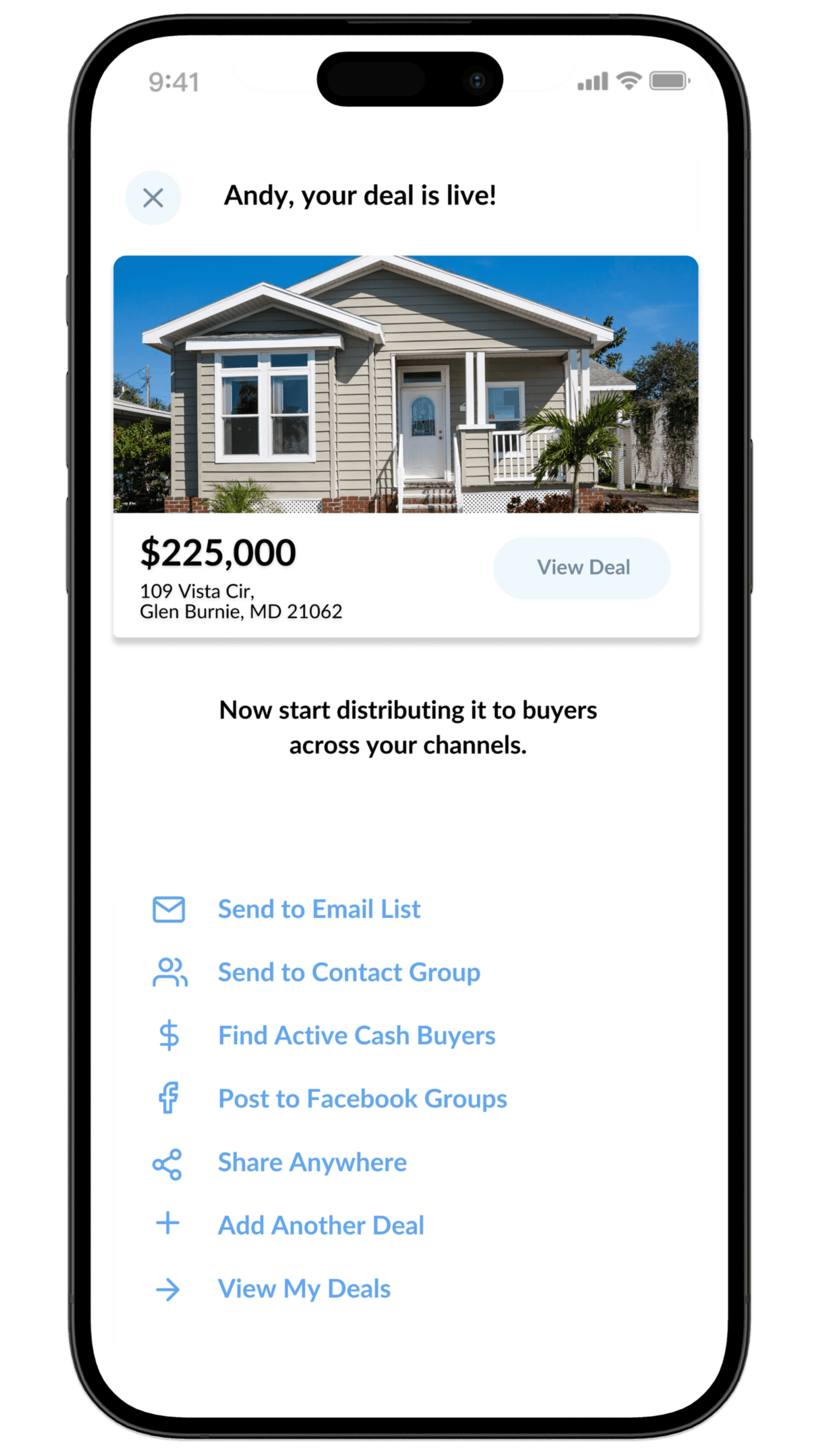
One deal. Multiple channels. One system to keep distribution connected back to your workflow.
You own the buyers. You own the relationships. You own the process.
Wholster gives that operation somewhere to run — so building an internal disposition capability does not have to mean building every piece of infrastructure yourself.
See the complete disposition workflowTwo ways to move the deal. Two very different things to own.
Both models can get a property sold. The difference is how much work stays inside your company, how the economics behave, and what remains after the transaction closes.
The right model depends on what you want your company to become.
This is not simply a software-versus-service decision. It is an operating decision about where you want the capability to live.
You want the buyer-side work off your plate.
You would rather stay focused on acquisitions, need immediate access to an established network, or simply value the time saved more than the portion of the assignment you give up.
You want to own the capability.
You are willing to run the process, want direct buyer relationships, and see value in keeping more of the economics while building an operating asset that strengthens over time.
One model rents the capability. The other builds it.
The better fit depends on how much work you want to own today — and how much infrastructure you want your business to own tomorrow.
Build capital and capability at the same time.
Done-for-you disposition can solve a real operational problem. But if you want the buyer relationships, market knowledge, distribution infrastructure, and more of the transaction economics to stay inside your business, building the function can create value far beyond one deal.
Find opportunities. Reach buyers. Own what you build.
Wholster brings property data, active buyer discovery, and deal distribution into one platform built for real estate investors.