
What is skip tracing in real estate?
Skip tracing helps investors connect property records to the people behind them. Learn how real estate skip tracing works, what contact data you can find, when to use it, what affects match quality, and how better property targeting can lead to better outreach.
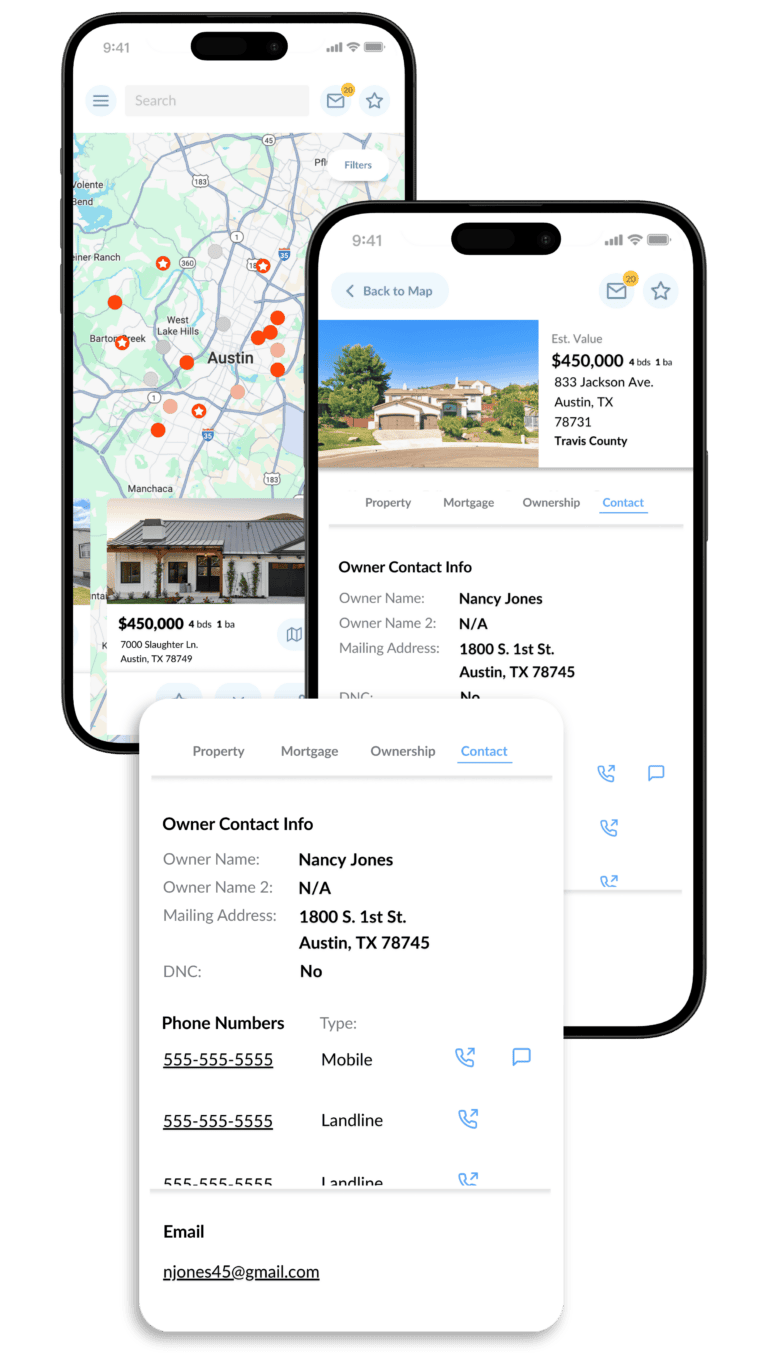
Skip tracing in 30 seconds.
Real estate skip tracing connects four parts of the acquisition process: the property, the owner, available contact information, and the outreach that follows.
Find a property
Start with one property or a group of properties worth researching.
Identify the owner
Connect the property record to the individual or entity associated with its ownership.
Retrieve contact data
Find available phone numbers, email addresses, and mailing information associated with the owner.
Start outreach
Use an appropriate outreach channel to begin a conversation with the owner.
From an address to the person behind it.
A real estate skip trace takes the property or owner information you already have and attempts to connect it with usable contact data. Results vary based on the property, owner, and data available.
Skip tracing results vary. A returned phone number, email address, or owner match does not guarantee that every result is current, reachable, or still associated with the intended person.
Individual and bulk skip tracing solve different problems.
Research one property.
You found a property, want to know who owns it, and need available contact information so you can decide what to do next.
Enrich a targeted list.
You have hundreds or thousands of property records and want to retrieve available owner contact information at scale for an outreach campaign.
Example: you spot a property worth researching.
Search the address, review the ownership and property information, then retrieve available owner contact data if the opportunity still makes sense.
Better outreach starts before the skip trace.
Skip tracing can help you understand how to reach an owner. It cannot tell you whether the property was worth pursuing in the first place. The strongest acquisition workflows begin by narrowing the properties and owners where additional research makes sense.
These are property, ownership, and distress signals investors can use to prioritize research. They do not prove that an owner wants or needs to sell.
How much does real estate skip tracing cost?
There is no single industry pricing model. What matters is not only the advertised rate, but what the provider considers a billable search, record, or match.
Per record
You pay for each property or owner record submitted for processing, whether or not every record returns useful contact data.
Per match
The provider charges when usable contact information is matched to a submitted record.
Credits
Searches or successful matches consume credits that may be included with a plan or purchased separately.
Subscription
Skip tracing may be bundled into a broader real estate data or lead generation subscription with usage limits or included credits.
The lowest advertised price is not always the lowest effective cost. Compare what you pay for, how matches are counted, and how useful the returned data is for your actual workflow.
Not all contact data is equally useful.
Comparing skip tracing providers is about more than asking who returns the most phone numbers. Consider how usable the information is for the workflow you actually run.
Freshness
People move, phone numbers change, ownership transfers, and mailing information becomes outdated. More current source data can improve usefulness.
Match confidence
More returned numbers do not automatically mean better results. Prioritization or confidence signals can make contact data easier to work.
Useful context
Phone type, mailing information, ownership details, and DNC indicators where available can help investors use returned data more intelligently.
Billing model
Understand whether a provider charges per search, per record, per successful match, through credits, or as part of a subscription.
Match rate isn’t the same as accuracy.
Match rate
The percentage of submitted records for which a provider returns some form of contact information.
Accuracy
How often the returned information actually belongs to, reaches, or remains associated with the intended person.
A provider can return contact information for a high percentage of records without every result being current or useful. That is why freshness, confidence, context, and real outreach performance matter more than a single headline percentage.
How real estate investors use skip tracing.
“I found a property. Who owns it?”
Research a specific address, identify ownership, review the property, and retrieve available contact data when the opportunity looks worth pursuing.
“I built a list. Now I need the owners.”
Narrow properties using ownership, equity, distress, or other opportunity signals, then enrich the matching records for outreach.
“I found this house in the field.”
Turn a property you discover while driving or researching a neighborhood into an owner record you can investigate further.
“I know the property. How do I reach the owner?”
Retrieve available contact information and choose an appropriate communication channel for your acquisition strategy.
Contact data only matters if you have a plan for it.
Real estate investors use different outreach methods depending on their market, strategy, team, and the information available for each owner. No single channel is right for every situation.
Phone
Useful when your acquisition process relies on direct conversations with property owners.
Text messaging
A concise way to initiate or continue a conversation when the channel and circumstances make its use appropriate.
Direct mail
Gives owners a physical message and remains useful when a usable digital contact match is unavailable.
Provides another communication channel when an email address is available and its use is appropriate.
Follow-up
Organizing prior conversations and future follow-up connects the individual channels into a repeatable acquisition process.
10,000 targeted properties. One deal. $74K net profit.
Lauchman Real Estate used a targeted property list and owner contact data to build an outreach campaign in its market. Within the first month, the team generated 93 leads, made 27 offers, booked seven in-person appointments, and closed one deal.
Real estate skip tracing FAQ
What is skip tracing in real estate?
Real estate skip tracing is the process of connecting a property or owner record with available contact information such as phone numbers, email addresses, and mailing information. Investors use it when they want to research or attempt to reach property owners directly.
What information does real estate skip tracing provide?
Depending on the provider and the available match, results may include mobile and landline phone numbers, email addresses, mailing addresses, owner identity information, and additional context related to the record.
How accurate is real estate skip tracing?
Accuracy varies by provider, data source, property, owner, and age of the underlying information. A returned result is not a guarantee that every phone number, email, or address is current. Investors should distinguish between a provider’s match rate and the real-world accuracy of the returned contact data.
What is a skip tracing match rate?
Match rate usually refers to the percentage of submitted records for which some contact information is returned. It does not necessarily mean that the returned information is correct, current, or reachable.
Can you skip trace one property?
Yes. Individual property lookup is useful when you discover a specific property and want to identify the owner, research the record, and retrieve available contact information without first building a large list.
What is bulk skip tracing?
Bulk skip tracing processes multiple property or owner records at once. Investors commonly use it after building a targeted property list so they can retrieve available contact data for many records before beginning an acquisition campaign.
How much does real estate skip tracing cost?
Pricing models vary. Providers may charge per search, per submitted record, per successful match, through monthly credits, or as part of a subscription. Comparing providers requires understanding both the advertised price and what counts as a billable result.
Do I need an owner’s name to skip trace a property?
Not always. Property-focused platforms can often begin with an address or property record, identify associated ownership, and then attempt to retrieve contact information connected with that owner.
What makes a good property list for skip tracing?
A good list is targeted around the properties and owners that fit your acquisition strategy. Investors may use ownership, equity, vacancy, property condition, distress, inheritance, or other signals to prioritize where additional research and outreach make sense.
Is skip tracing the same as finding motivated sellers?
No. Skip tracing helps retrieve contact information. It does not prove that an owner is motivated to sell. Property and ownership signals can help investors decide which opportunities to research, but motivation ultimately has to be discovered through the owner’s circumstances and conversation.
What should I do after skip tracing a property?
Review the property and owner information, decide whether the opportunity still fits your strategy, choose an appropriate and compliant outreach method, and keep a system for tracking conversations and follow-up.